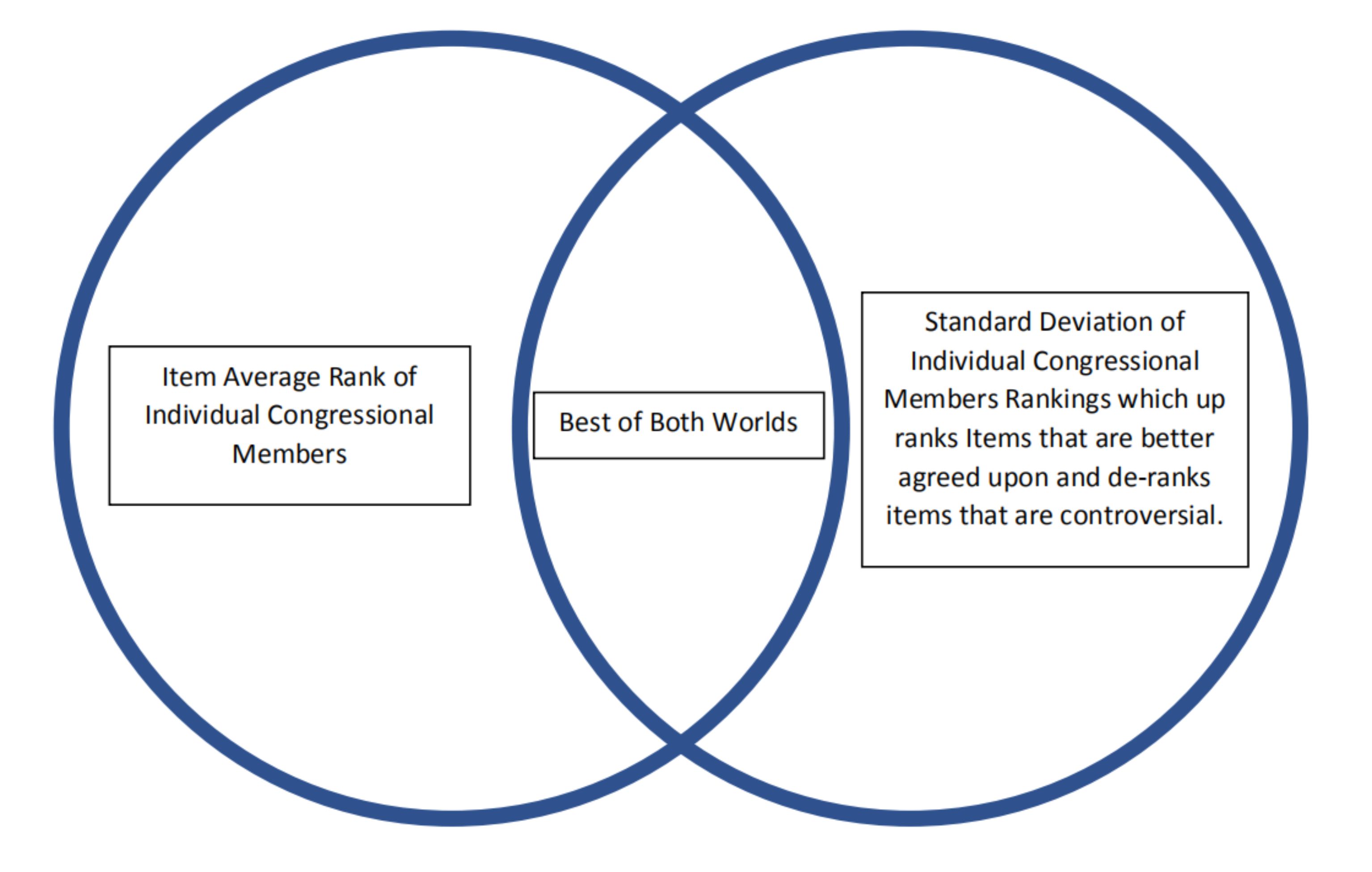
AVESTDEV Rank order budgeting is ranking budget items via their average rank plus their standard deviation times a multiplier to adjust the relative importance of the standard deviation relative to the average in the rankings (AVESTDEV = ()). For the sake of simplicity in this paper the multiplier is set to one to 1. What this equation does is rank items via average priority number and then de-rank them based on their standard deviation. In a congressional budget, items that are controversial will have a larger standard deviation and will be bumped down the list. Items that are largely agreed upon with be moved up the list. Items that are ranked with a low rank high priority number like 1 are moved up the list and items with a high rank low priority number are moved down the list.
The purpose of this type of budgeting is to pass a budget of the highest ranked and least controversial items in order to avoid a government shutdown on these items and to leave the low ranked and controversial items for a secondary budget fight. It also allows us to observe the values of our congress people by assessing how they ranked items. Is military spending more important than law enforcement? Is the environment more important than social welfare spending? And it allows us to measure exactly how controversial items are in congress with the standard deviation. Some of the things people might think are controversial may not be and vice versa.
Here is a sample ranking of ten representatives concerning 10 budget items. The items may have dollar amounts attached to them in the title which may be established by the budgeting committee with help from a think tank like the CBO. The rankings can be done online by the representatives sorting the list into a priority funding list. The number order of the list is then used to give each item a priority number which is then fed into the average and standard deviation calculation

Notice how item 5 is all ranked the same by everyone it is both non-controversial with a standard deviation of 0 and it is likely near the middle of a budget if only an item or two gets cut. It is likely to get funded no matter what. In this ranking method item 5 ends up being ranked number one. Let’s compare this to item 10 which is low ranked but uncontroversial. Item 5 moves up the rankings, but item 10 stays last. Our ranking system could make it even lower if it was more controversial. If two congress people change their ranking on item 10 to 1, then our equation spits out its lowest rank number of 11.99, either way it is still last. This phenomenon lends this method to some strategic rankings around items near the cutoff if the likely rankings of other parties are known. However, this is unlikely with any certainty and congress people are will be also be incentivized by how their rankings are published. If you are the party in power, it is easiest to just pass additional items in the secondary budget.

Notice how many duplicate items there are when only an average is used to rank budget items. If the budget could only hold the top seven items, item 1 and 3 could both get kicked out if your rule is to provide a balanced budget or surplus. This is the only tie that matters. The major drawback of using only an average is that super controversial items that would normally fail with a majority vote would get through because a handful of representatives made it number 1 to draw up the average enough to pass the cutoff. Further refinement is needed.
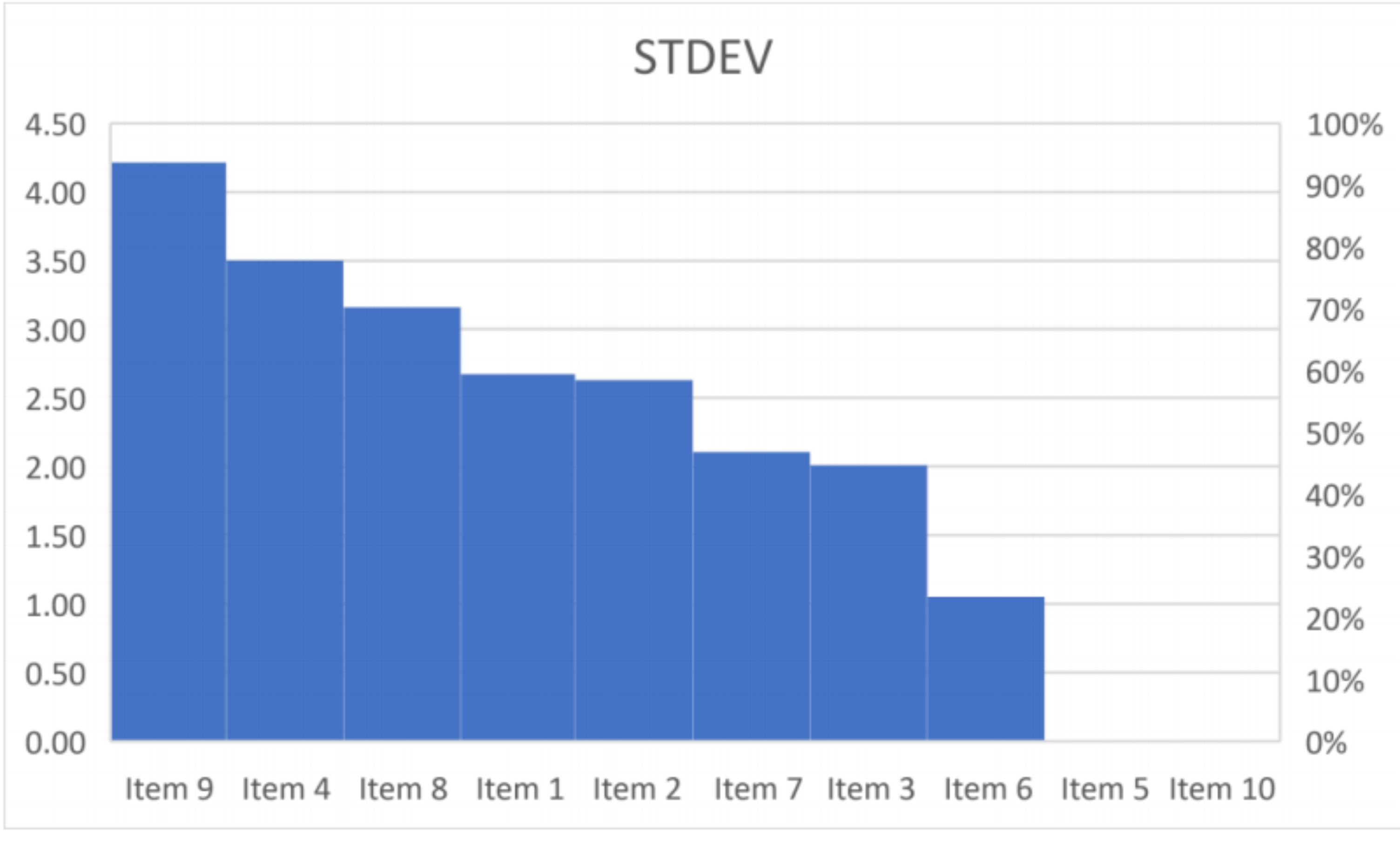
Standard deviation is a measure of how far apart the data points from the mean and a measure of how controversial the item is. If Item 10 is funding for ISIS and item 9 is Border Wall or Abortion funding, item 10 ISIS funding may get funded if standard deviation is the only determiner of rank even though it is last on everyone’s list while Border Wall or Abortion funding wouldn’t have a chance because it is controversial even if it had enough votes to pass.
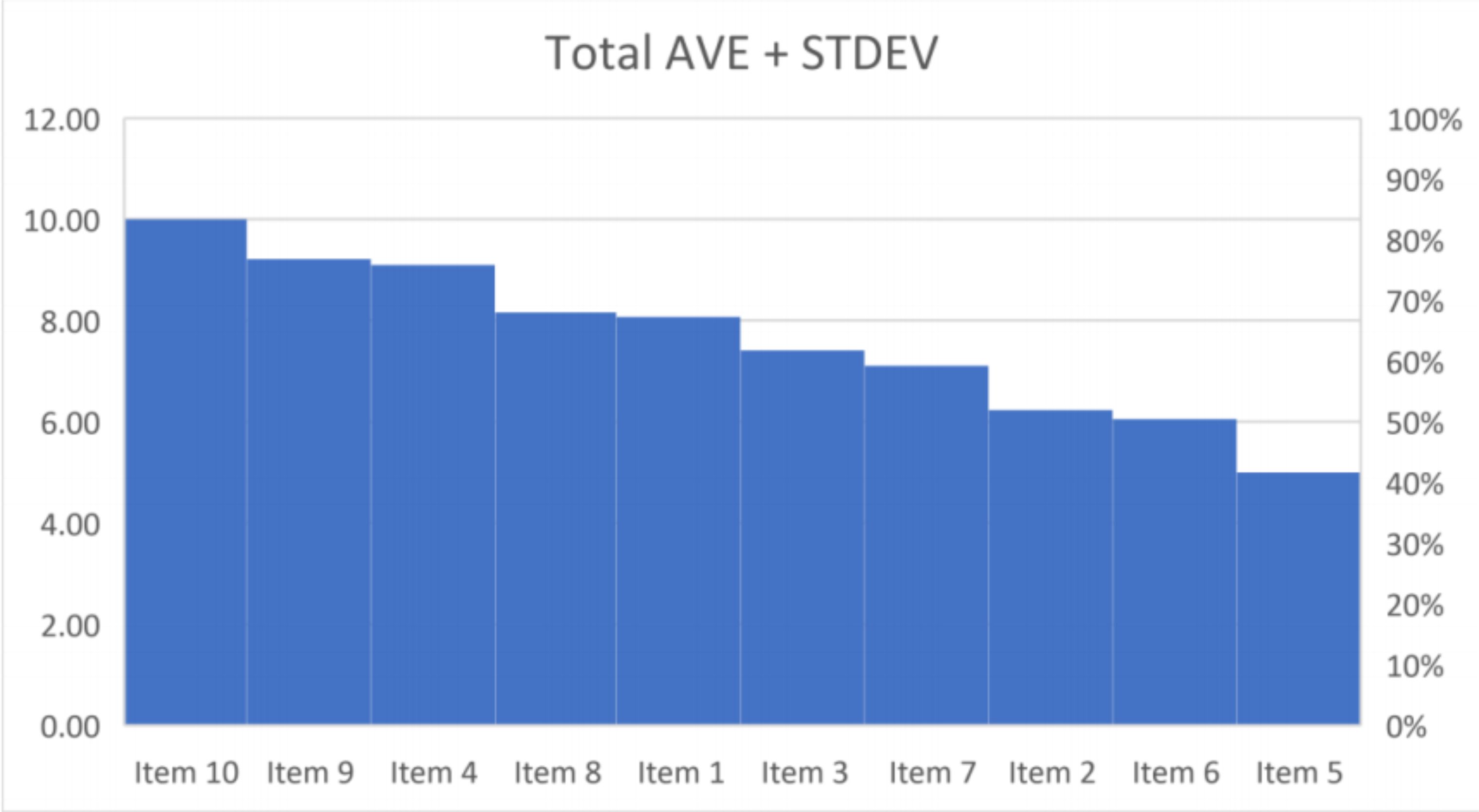
Here item 9 is now ranked second to last instead of last giving it a slight edge over item 10 and possibly receiving funding depending on where the cutoff is. Likely it will be kicked out of the primary budget and may be passed by the party in power in a secondary budget. But with a primary budget passed some level of security is given to government agencies and a government shutdown is avoided on those items due to the representative’s high rankings and collective agreement.
Budget cutoffs are determined arbitrarily with the influence of data on expected revenue and expected borrowing. I recommend a cutoff set at about 80% of expected revenues for the primary budget leaving the last 20% for controversial and low priority items in the secondary budget. Borrowing should only be used in emergencies and for “hell a good” investments.
In summary an AVESTDEV budget rank items by the sum of their average rank plus their standard deviation time a multiplier (usually one). an AVESTDEV budget is passed in order to avoid a government shutdown on the highest ranked and least controversial items, to provide agencies and programs with a level of financial security, to observe the controversial nature of items, and to determine the values of congress people.
 Improving Our Economy