Category Archives: Uncategorized

Taxing Serial Killers To Eliminate Serial Killers

Jail time is expensive so is detective work, prosecution, and courts. Law abiding citizens end up paying for much of this. It would be nice to shift more of the burden back on the criminals themselves. If they have any assets they can be confiscated and sold after they are convicted in order to pay for their time in jail…However this post is about taxing them before they are caught, before we even know who they are, and perhaps even before they even commit the crime.

In I Thessalonians 5:22 the Bible states (depending on translation) “Abstain from all appearance of evil.” or just “abstain from every form of evil”. It is the “appearance of evil” translation that is useful to us when trying to determine how to tax serial killers and criminals before they get caught. If serial killers are statistically known to wear red vests in a higher percentage that the rest of the general population we can tax red vests at a higher percent than other goods in order to pay for investigations into serial killers, jail time, etc. Taxing this item a little bit higher will unlikely changed the serial killers behavior and he will keep buying red vests. Taxing red vests a lot may cause him to start seeing blue vests in a new light and his behavior may change. By layering on many small taxes on the variant behavior of criminals we can cause them to end up paying more in taxes (statistically) than the general public which will in turn help pay for all the costs they bear upon society. The lower taxes paid by the general public can either be refunded thus making a subtraction leaving only those likely to be criminals paying taxes or the money can be earmarked for other things like roads and bridges.

Now obviously this type of taxation can be abused and it isn’t perfect to begin with. Some innocent people will fall though the cracks and pay more in taxes because they share similar characteristics to criminals and some criminals will only pay the minimum amount because they don’t. Some bad actors may tax non-behavior characteristics like race, gender, or the physical state a person is born with and unlikely to be able to change. Other bad actors may use this tool to tax their political opponents or religious groups they don’t like. There is also transactions costs to consider as having a complicated tax system has a cost in an of itself. While this form of taxation is not perfect it is better generally for members of society as those who are good pay less and those who are evil pay more…statistically.
AVESTDEV Rank order budgeting

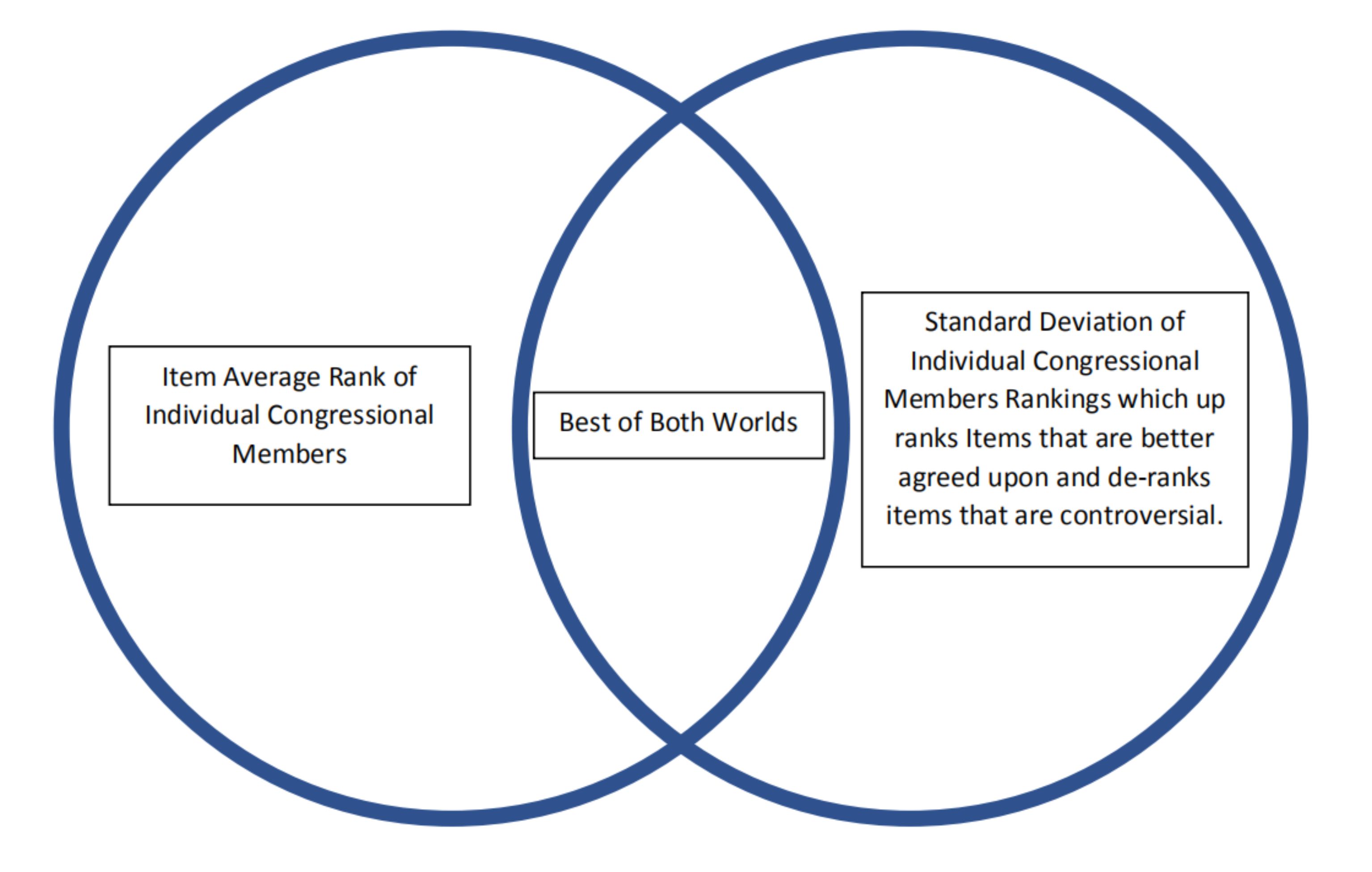
AVESTDEV Rank order budgeting is ranking budget items via their average rank plus their standard deviation times a multiplier to adjust the relative importance of the standard deviation relative to the average in the rankings (AVESTDEV = ()). For the sake of simplicity in this paper the multiplier is set to one to 1. What this equation does is rank items via average priority number and then de-rank them based on their standard deviation. In a congressional budget, items that are controversial will have a larger standard deviation and will be bumped down the list. Items that are largely agreed upon with be moved up the list. Items that are ranked with a low rank high priority number like 1 are moved up the list and items with a high rank low priority number are moved down the list.

The purpose of this type of budgeting is to pass a budget of the highest ranked and least controversial items in order to avoid a government shutdown on these items and to leave the low ranked and controversial items for a secondary budget fight. It also allows us to observe the values of our congress people by assessing how they ranked items. Is military spending more important than law enforcement? Is the environment more important than social welfare spending? And it allows us to measure exactly how controversial items are in congress with the standard deviation. Some of the things people might think are controversial may not be and vice versa.

Here is a sample ranking of ten representatives concerning 10 budget items. The items may have dollar amounts attached to them in the title which may be established by the budgeting committee with help from a think tank like the CBO. The rankings can be done online by the representatives sorting the list into a priority funding list. The number order of the list is then used to give each item a priority number which is then fed into the average and standard deviation calculation

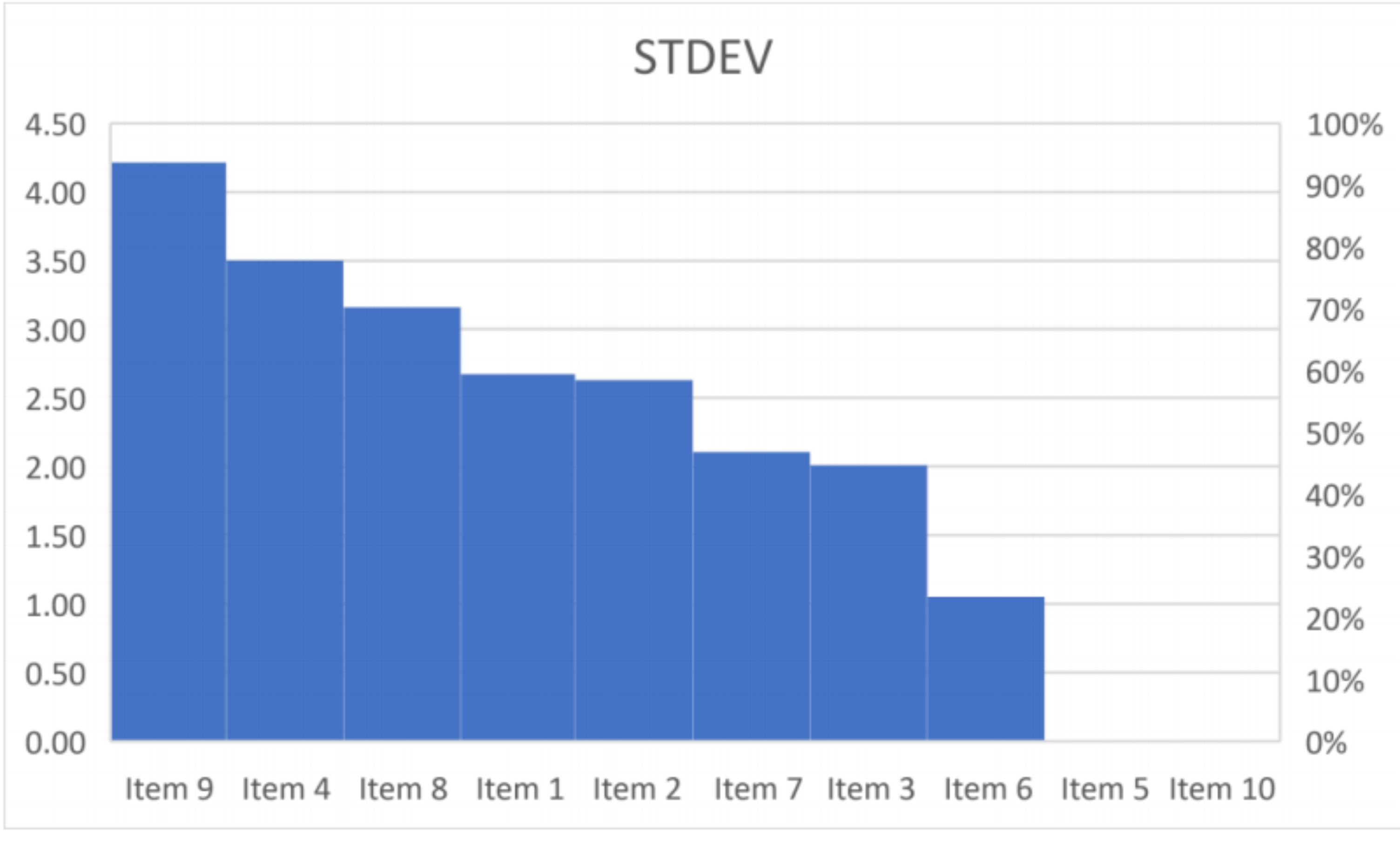
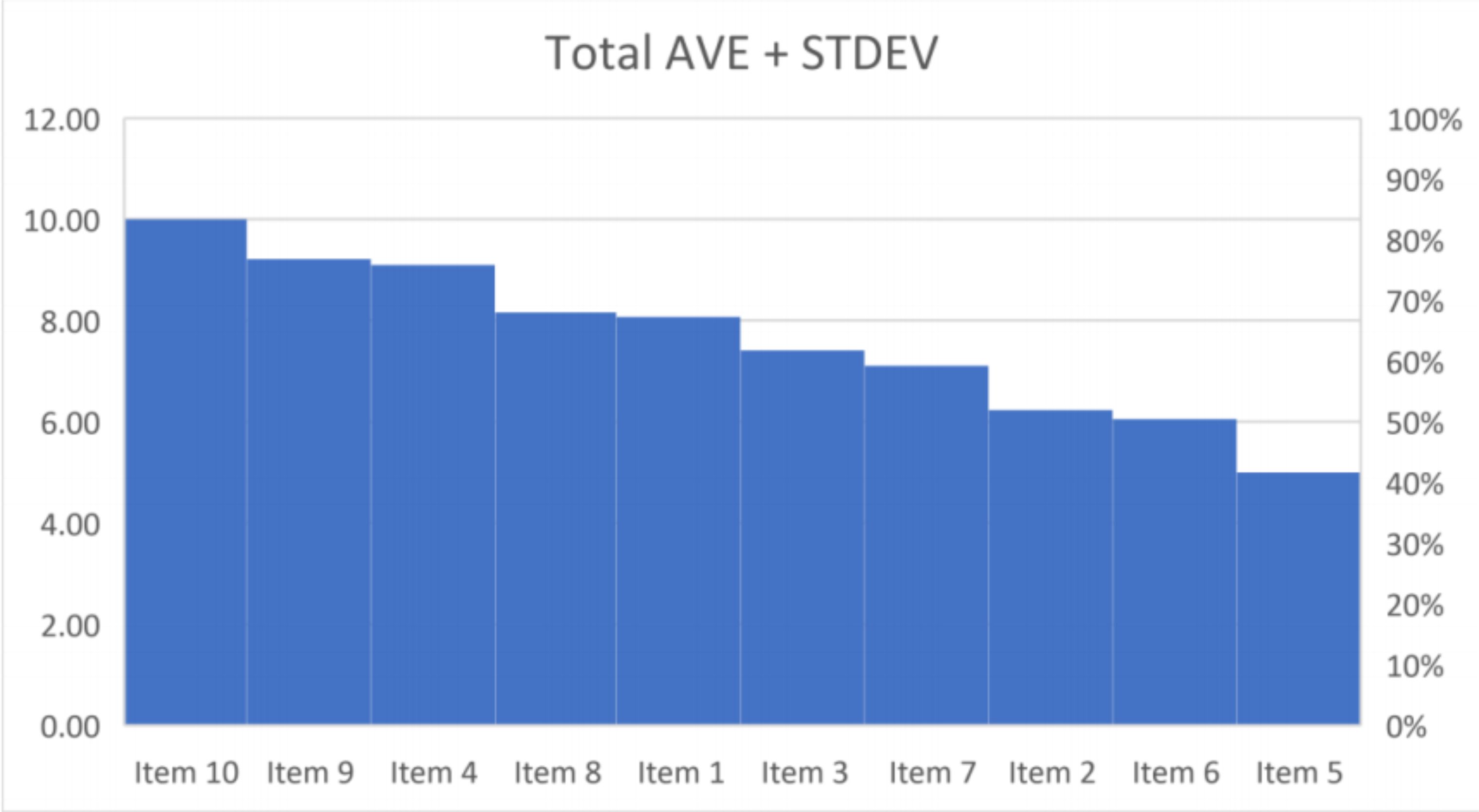
Notice how item 5 is all ranked the same by everyone it is both non-controversial with a standard deviation of 0 and it is likely near the middle of a budget if only an item or two gets cut. It is likely to get funded no matter what. In this ranking method item 5 ends up being ranked number one. Let’s compare this to item 10 which is low ranked but uncontroversial. Item 5 moves up the rankings, but item 10 stays last. Our ranking system could make it even lower if it was more controversial. If two congress people change their ranking on item 10 to 1, then our equation spits out its lowest rank number of 11.99, either way it is still last. This phenomenon lends this method to some strategic rankings around items near the cutoff if the likely rankings of other parties are known. However, this is unlikely with any certainty and congress people are will be also be incentivized by how their rankings are published. If you are the party in power, it is easiest to just pass additional items in the secondary budget.

Notice how many duplicate items there are when only an average is used to rank budget items. If the budget could only hold the top seven items, item 1 and 3 could both get kicked out if your rule is to provide a balanced budget or surplus. This is the only tie that matters. The major drawback of using only an average is that super controversial items that would normally fail with a majority vote would get through because a handful of representatives made it number 1 to draw up the average enough to pass the cutoff. Further refinement is needed.

Standard deviation is a measure of how far apart the data points from the mean and a measure of how controversial the item is. If Item 10 is funding for ISIS and item 9 is Border Wall or Abortion funding, item 10 ISIS funding may get funded if standard deviation is the only determiner of rank even though it is last on everyone’s list while Border Wall or Abortion funding wouldn’t have a chance because it is controversial even if it had enough votes to pass.

Here item 9 is now ranked second to last instead of last giving it a slight edge over item 10 and possibly receiving funding depending on where the cutoff is. Likely it will be kicked out of the primary budget and may be passed by the party in power in a secondary budget. But with a primary budget passed some level of security is given to government agencies and a government shutdown is avoided on those items due to the representative’s high rankings and collective agreement.

Budget cutoffs are determined arbitrarily with the influence of data on expected revenue and expected borrowing. I recommend a cutoff set at about 80% of expected revenues for the primary budget leaving the last 20% for controversial and low priority items in the secondary budget. Borrowing should only be used in emergencies and for “hell a good” investments.

In summary an AVESTDEV budget rank items by the sum of their average rank plus their standard deviation time a multiplier (usually one). an AVESTDEV budget is passed in order to avoid a government shutdown on the highest ranked and least controversial items, to provide agencies and programs with a level of financial security, to observe the controversial nature of items, and to determine the values of congress people.

Share Based Currency

A share based currency system is one that treats every dollar like a share that is backed by trad-able goods and services in the market. When you offer a good or service for sale you are officially backing the currency and this can be explicit or implicit.

Managing the currency is done through splits and reverse splits, dilution, and uneven splitting based on a set of rules to adapt to the local economic condition. This would make everyone wealthier when the economy goes up as their shares would split in their accounts to avoid deflation. This would drive up demand for our currency causing more splits allowing us to buy more in this world. Also as local economic conditions are better adapted to there are less dead spots in the economy. This is like targeted fertilizer to just those plants that need it.

If a major natural disaster hits some area the currency in and around that area can be swelled amongst the poorest hardest hit people to help them get back on their feet. This is akin to swelling in the body that allow blood and resources to get to the area to help heal a wound. Likewise if a new butcher comes to town and expect to do $25,000 of business over the next quarter than another $25,000 needs to be added to the economy over the next quarter preferably amongst his customers and their customers so that they can earn the money to buy his good. This is done with targeted share splits in people accounts. If enough timely information is collected this can be done at the point of transaction otherwise it can be done by guesstimation and tacking with reported results.

With this type of currency a dollar here could be the same as a dollar on Mars as the exchange rate is already taken care of and adjusted to actual transactions by adjusting the volume of shares in each place.

Draw backs of a share based currency system include a lot of power in the hands of currency managers which would need to be checked and the possibility of abuse of that power. A share based currency system that took transaction data at the point of transaction via chipping people could easily be called an Antichrist currency and which as the prophecy goes comes at the expense of religious freedom which is true wealth in exchange for material wealth. T’is something to avoid.

Things the Fed can do to increase the real wealth of the Average American

How can the Fed do anything to increase the wealth of the Average American? Isn’t real wealth products, property, and services?

The answer is that money itself is a product that is traded in the market place like any other product. If real value is added to the currency those who own it become wealthier.

How can value be added to the Currency?

Value can be added to the currency by making it more useful, more stable, more secure, easier to handle, making it economically self adjusting, and creating it is such a way that does harms the economy less and promotes the economy more.

How is this different from the currency that we have?

Our current currency is mostly created by the fractional reserve system via debt and being implicitly backed by all goods and services in the market. A reformed currency would be explicitly backed by as many goods and services in the market as it is cost effective to do so and not backed via debt which has many hidden costs. A reformed currency would attempt to achieve equilibrium between all markets as well as stability to the markets as a whole over time. A reformed currency would not just be a currency but a mutual fund investment of all trad-able goods and services in the markets. Owning a dollar would be owning a share of a growing economy and these shares would split and reverse split to maintain share stability to the market as a whole. This make the reformed currency much more valuable because it is easier to manage than the old currency which must split it’s effort between creating enough flowing currency to help people meet their debt obligations and creating enough flowing currency for economic growth. One interest comes at the expense of the other. The reformed currency would help people build wealth by being an investment, by being more stable, and by removing the very cheap looking but very expensive debt costs from the equations.

How do we get there?

Reform usually should be taken slowly and with appropriate transition (baby) steps. This allow people to adapt more easily to the change and not suffer for decisions made under the old system. My first recommendation is to transition from a fractional reserve system to a full reserve system by slowly increasing the federal reserve requirement on new loans. This grandfathers older loans in and allows banks to adapt. On the backside the fed will have to replace money taken out of the fractional reserve system and they can do this by creating money out of thin air and introducing it to the market by the purchase and cancellation of federal debt. This will eventually wipe out the national debt and allow the transition to a full reserve system. From there we begin to start backing the currency by goods and services in the market. This is mostly a reporting requirement that requires that expected sales of good and services be reported and recognized as backing the currency and actual sales as having baked the currency. Expectations are a future indicator and actuality a lagging indicator, between the two we can create enough currency to meet demand and adjust for reality. Reporting would start with the major transactions and the easily reported transactions and eventually move to smaller transactions as it is cost effective to do so. We do not want the costs of the reform to out way the benefits of the reform hence the careful proceedings.

How will the Average American receive this increase in wealth?

The average American will receive this wealth in the form of a nation without debt, a much higher economic growth rate, and increasing wealth in their accounts as the economy grows.


Three ways to wipe out the National Debt

Spend less, pay down Principal

  • This requires tough budgetary sacrifices to create a budget surplus which can then go toward paying down principal. In order to do this we need to determine what the minimal role of government should be and set priorities from there… politics be damned. This means minimal leadership, law, and law enforcement/security, all else is extraneous.

Convert Public debt to Private debt

  •  If I owe you $100 every month for the next year and you owe me $100 every month for the next year we can simply sit down and cancel each others debt. We can do the same thing with the government’s debt and tax-payers who also own the debt. To do so we create a trad-able financial instrument that represents debt paid off and provides a tax break equivalent to a principal and interest payment on the debt for some duration into the future. It is also a good idea to split out the debt based on the debt to tax revenue ratio so that people understand how much debt is their responsibility.

Create Wealth, pay down Principal.

  • Turn the currency into an investment by making it into shares of a mutual fund of all trad-able goods and services in the market. This is the equilibrium and the definition of stability between markets also it is an explicitly backed currency, both add value. As the economy grows so does the shares of currency in your accounts through stock splits. This will help drive up demand for our currency increasing the number of shares in people accounts as the fed maintains share stability.
  • As you transition to the new currency first move to a full reserve system by increasing the federal reserve requirement on new loans thus shrinking fractional reserve created currency which the fed will replace by creating it out of thin air and introducing it to the market by the purchase and cancellation of Government debt. This creates a more stable banking environment and removes currency created via debt increasing the value of the currency. Yield for the Government $10.75 trillion dollars of debt wiped out. Add the $2.54 trillion dollars the fed currently owns and new currency needing to be created to keep up with economic growth and the full debt can eventually be wiped out. Yield for currency holders is more money, less debt, greater economic stability, and a higher economic growth rate.
  • Move the banking industry away from lending financing and toward non-lending financing. Lending financing has a tendency to place people and businesses in difficult positions that are not conducive to real wealth building, often credit financing invests in non-performing assets, businesses, and ideas simply because they can make the payment. Non-lending financing is essentially joint investment and wealth creation is the name of the game. This leads to higher economic growth rates meaning more tax revenue and fewer of the costs of debt upon society (divorce, stress, failed relationships, difficult to recover from financial situations, etc).

*As a note I believe that we will need all three approaches to wipe out the National Debt quickly but my preference lies in reverse order, create wealth, convert debt, and then spend less.

With all Hope,
Joshua Smith, Brier WA

On going list of the costs of Debt.

This is an ongoing list of the costs of Debt which I shall add to as time goes on. Many items will seem to be repeats or the same thing in different words and some are just subtly different. They are so just forgive me. This is more of a brainstorm than anything else. If you have anything to add than add it in the comments and I will add it to the list when I get around to it.

Interest

Fines

Fees

Reputation Risk/Loss

Over inter-connectivity

Non-intuitive nature of Compound Interest

Greater Debt than necessary in society due to Debt Chains and Debt Loops

Puts people financially in the Red

Puts Businesses Financially in the Red

Budget Stress

Human Stress

Increased investment in non-performing Assets

increased investment in non-performing Businesses

Increased investment in non-performing Ideas

Amplifies Business cycles

Amplifies budget swings in non-fixed expenditures

Contributes to Divorce and broken Families

Contributes to stress related health problems

Contributes increased death resulting from health problems and suicide

Contributes to financial related health problems

Contributes to stress related relationship problems in people’s personal lives

Contributes to stress related relationship problems in people’s professional lives

Psychological costs of debt

Appearance of financial weakness

Fails to directly promote wealth creation

Ties up money

Lost opportunity costs

Investments made by shortsighted borrowers less likely to be as good as an investment as those by farsighted investors

Allows overly easy access to capital resulting increased poor usage and subsequent problems

Government “investments” via debt are less responsive to the Market feedback loops that keep good investments and eliminate bad investments resulting in less real wealth creation per dollar invested(if any).

Fails to align the interest of the Banks with that of their clients

Fails to maximize the profits of Banks

Fails to help banks build the wealth of their clients while at the same time building theirs

Fails to have unlimited profit potential

Remains overly dependent upon conditions of the economy as a whole and interest rate rather than the economy of a banks clients

Fails as a product to significantly differentiate itself from other credit products creating a commodity, increased competition, and less profit for banks.

Subjects Nations to more difficult financial choices than need be

Increase the Gap between Rich and Poor

Contributes to National financial instability

Contributes to Business financial instability

Contributes to Personal financial instability

Slows economic growth

Divides the interest of the Fed between creating enough flowing currency for people to meet their debt obligations and creating enough currency for  economic growth. Unless they happen to be the same they cannot do both.

Lending with the fractional reserves system leave part of currency creation in the hands of the Fed and part of it in the whims of the banks leading to instability and improper currency management.

Enslaves the Borrower to the Lender

Increases risks to Borrowers

Does not adjust well to fluctuating revenues

Inflexible

Puts people in difficult to recover from financial conditions

Places the burden of responsibility on the least responsible party…the borrower for repayment

The hidden costs of debt are indeed a cost of debt making for poor decisions

In the light of alternatives (joint investment and other non-lending forms of financing) credit financing has the greatest problems and the least benefits.

Costs of Bankruptcy(lawyers, courts, etc)

Costs of Foreclosure(lawyers, courts, etc)

Costs of Collection(lawyers, courts, etc)

Contributes to crime

Slows the flow of Assets through the economy

Invests based on collateral and (current) ability to make payment rather than on the quality of the underlying investment.

Leads a large percentage of financing to be in non-performing assets, businesses, people, and ideas which leads to slow economic growth.

Comes at the expense of focused real wealth creating joint investment

Expands the gap between rich and poor leading to french revolution style reforms (off with their heads)

Wiping out the National Debt Part 2

In part one I presented the best of ideas that would eliminate debt without raising taxes or cutting spending. Ideas like moving from a fraction reserve system to a full reserve system, eliminating intragovernmental debt, handing the debt back to the tax-payers many of which also own the debt, and increasing the value of the currency so that everyone becomes wealthier. Now lets talk about cutting spending and raising taxes. In order to cut spending to it’s max we need to have a discussion as to what the minimal role of government should be. What does a bare bones government look like? A minimal government has someone to govern and a people to be governed. The act of governing is one of laws and law enforcement/security. In short; leaders, law, law enforcement/security.  All else is extraneous and not a primary function of government. With respect to US Federal law a minimalist approach would be to limit Federal government and law to only that which is explicitly addressed in the constitution rather than to that which is not expressed. While a bare bones government may not be popular, it is an essential mental exercise necessary for determining spending priorities and the limits of scaling a government down. What is the minimal amount of leadership that we need? What is the minimal amount of law that we need? What is the minimal amount of law enforcement/security that we need? With respect to leaders in a representative government we need enough leaders to be represented well. We need enough leaders to oversee the government and keep it in check. The minimal amount of law enforcement/security is dependent upon the law that need enforcing, how they are enforced, the level of societal morality, and the external threat level. Determining the right amount of government is difficult and is a battle  that is waged everyday. Because of the controversy that surrounds it, it remains the most difficult way to pay off the debt as the country would have to run surpluses for a long time. For taxes Revenues to consistently be greater Government expenditure is nearly impossible with the interest of Politicians being as short-term as the next election cycle. Never the less it can be done and with a goal in mind it is important to work every angle.

The Economic Structure of Morality

Morality to most humans is relative. One culture’s Morality is different than another’s. What is right in one culture is often wrong in another culture and to an extent I would agree with them. I would agree with them because I believe that the universe is constructed out of discreet love relationships and if it ain’t love it ain’t moral. Morality for me is constructed from the big picture scoping done to the small picture and from the eternal down to the present. Morality to me is about general profitability How profitable is the decision? If a decision is profitable on a universal and eternal scale than it is moral. But that’s not the whole story because morality is about Maximizing profitability. So now we have to look at whether the decision maximized profitability on the universal and eternal scale. Does it? We are silly humans how can we know? Now I talked about the scoping nature of morality and I wish to point out that a moral decision will first be universal and eternal in nature and then it regional and long-term before local and present. This means when we are determining the morality of a decision we must first ask “Does this decision maximize profitability on and universal and eternal scale? If so..Does this decision maximize profitability on a regional and long-term scale? If so… Does this decision maximize profits to me here and now? Let’s take murder as an example. Suppose it was in your interest to murder someone in the here and now and you would profit greatly. But on an eternal scale you risk the fires of hell and eternal condemnation and on a long-term scale you may get caught and put in prison. On a societal scale you’ve increased fear in society, added to the murder rates, decreased the gene pool and eliminated future contributions of that individual to society…and individual society has invested in. Murder by this model would be wrong as it fails to scale properly from big to small. A society that is Just would seek to impose the costs that an individual imposed upon society back onto the individual. That is why the Hammurabi Code is still relevant today “An eye for an eye, tooth for a tooth, a life for a life” But even the Hammurabi code fails to impose the full costs of and individuals actions back onto the individual. With Murder, even if you killed the murderer the families are still traumatized the gene pool is still depleted, the murder rate was still increased, the investigation, courts, and police cost money, the lost opportunity cost of both the victim and the criminal are lost and much more. Actual justice would mean attempting to impose all the cost upon the criminal failure to do so would be injustice and we have a lot of injustice in our society today.

The Consequences of Debt “Reputation”

“Your only worth what someone will lend you” This is an old quote and is foolishly evil. A human beings worth is better stated in terms of their reputation and even better stated in terms of who they are as a person in private as well as public. Someone’s lending reputation is just a small part of their greater reputation and even a good reputation can fully overcome the current financial situation of an individual if it is bad. With debt we start view the value of individual in terms of debt and it devalues many. In our society credit reports are pulled for job interviews someone with a lot of debt may be a job risk as they be tempted to steal or betray, someone with too little debt may not be a good employee because they can walk at anytime unenslaved by debt. The United State sent gunships to Ecuador to enforce debt payments and Ecuadorians have a reputation of borrowing and not paying debt back. I had this Ecuadorian roommate once…. Investors are wary to lend money to countries that are a credit risk and their enemies view them as weak. Countries use debt risk of money they lent as an excuse to invade. In a nation with a fractional reserve system where the fed only has partial control over the money supply a citizen could be stuck with debt he is unable to pay because there is not enough currency flowing in the system for everyone to meet their debt obligation. Drawing the short straw or being a little vulnerable at that moment could mean the destruction of his reputation, his investments, and his life for being only a little at fault when most of the blame lies with the immorality of the system. Yeah that’s me. It sucks.

Economic Waste Profiteers

Someone who profits from economic waste is an economic waste profiteer. Now there are good and bad waste profiteering and plenty of gray area in between. so let’s parse it. First off profit is an incentive and in this case it is an incentive to keep or increase economic waste. If I run a blog that aims to cut economic waste in society and I profit from that blog where would I be if all that waste was to be cut? Clearly I would have to blog about something else. If a major cancer research facility found an easy cure for cancer, how many people would be out of a job? Would they hide it? If government simplified the legal system, would we really need so many lawyers? For a blogger the profit is very little and the transition to something else is easy. So the incentive to keep economic inefficiencies is very low. Suppose that the cure for cancer was simply the elimination of sugar and acid forming foods while drinking tumble weed root tea and eating high sulfur foods like broccoli sprouts. A major cancer research facility would have a very high incentive to not solve the problem but to only provide small incremental improvements because their jobs depend on it. They would appeal to people who want a magic pill instead of lifestyle improvements and continue chugging along. For the economy it would be best if they just cured it in a way that promotes the healthiest possible lifestyle and moved on to the next problem. But this is hard to do because so much is invested in Cancer. It is a popular disease. The good an bad in all this is dependent upon people ability to make sacrifices for the greater good. The blogger would be making a small sacrifice and the Cancer research president would be making a large sacrifice for the greater good at the expense of his employees. The harder something is to do the less likely it is to happen. I hope this statement is taken as a challenge.